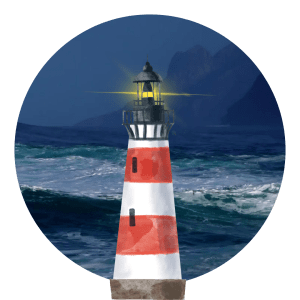

I’ll stick my neck out and say that Winstanley’s Eddystone lighthouse is the most spectacular in British history. If you ask me, no lighthouse in the world compares.
From the story of its creator to the circumstances of the build and the sheer ornamental beauty of the tower itself, this lighthouse is one of a kind.
As some of you may know, I’m so enamoured with Winstanley’s story that I dress up as him at the Travelling Pharology Archive pop-ups. (The costume gives visitors a talking point and gives me an opening to tell them about this remarkable man.)


From a London eccentric to a rock off Plymouth
Before he built a lighthouse, Winstanley ran a public attraction near what is now Hyde Park Corner. Visitors to Winstanley’s Waterworks came to see his entertaining contrivances involving water. Perhaps that was an early sign of his desire to conquer the waves at Eddystone.
The Waterworks and the lighthouse are Winstanley’s best-known creations. He was an extraordinary eccentric, and I thoroughly recommend Adam Hart-Davis and Emily Troscianko’s Henry Winstanley and the Eddystone Lighthouse for a closer look at his life. He lived in a wonderful world of whimsy, even adding ‘gent.’ after his name to give himself the airs and graces that weren’t afforded him at birth. It seems he saw every challenge as an opportunity. Fortunately or unfortunately, this led him to the Eddystone Rocks.
The Eddystone Rocks lie roughly 20 km south-west of Plymouth. The sea can hide much of the reef, so a ship could be well away from the coast and still come dangerously close to the rocks. Building a lighthouse there meant getting people, tools and materials out by boat. Imagine trying to step onto wet rock while the boat is still moving beneath you. Then imagine bringing everything you need to build a tower (in the 1690s, no less)!
When you see a picture of Winstanley’s lighthouse, you’d be forgiven for looking straight at the decoration. These days I find myself looking at where the building meets the rock. Someone had to fasten it down and trust that what they’d built would still be there the next time the weather let them land.
Building the most extraordinary lighthouse in British history
Winstanley began work in 1696, towards the end of the Nine Years’ War (1688–1697). England, under William III, fought alongside the Dutch Republic, Spain and other allies in the Grand Alliance to curb the power of Louis XIV’s France. The Peace of Ryswick ended the war in 1697, a few months after the raid on Eddystone (National Army Museum, n.d.).
The Admiralty had assigned a ship to protect those building the lighthouse, but in late June 1697 the escort was called away. A French privateer came to the rock, seized Winstanley and took him to France. The lighthouse was also partially destroyed.
Louis XIV is said to have ordered Winstanley’s release. This is the remark often attributed to him:
France was at war with England, not with humanity.
~ Louis XIV
The crew carried on after this slight hiccup, and the first light was shown on 14 November 1698.
For several years, people tended the light and ships used it to find their way past the reef. Before the lighthouse was built, hundreds of ships had been lost on the rocks. Thanks to Winstanley’s determination, ships could navigate this dangerous part of the English Channel more safely.

The Great Storm of 1703
Then came the Great Storm of 1703. Winstanley had been warned about a huge storm rolling in, but he remained steadfast in his belief that the lighthouse could withstand anything. He rowed out to the lighthouse, ignoring the warnings.
This hubris was, unfortunately, his undoing. The sea claimed Henry Winstanley, gent., and his lighthouse. Everyone who could tell us what happened inside the tower that night was lost to the waves.
The reef was still there, the sea was as treacherous as ever, and ships were still passing it.
The need for a lighthouse remained.
John Rudyerd’s replacement tower followed in 1709, and John Smeaton’s in 1759. The current tower, designed by James Douglass, dates from 1882.
Thank you
This blog post is based on ‘The Lighthouse That Killed Its Creator’, the online talk I gave on 18 November 2026. Lighthouse Explorers is currently running weekly talks, both in person and online, sharing snippets of lighthouse heritage.
Find out how to get involved with Lighthouse Explorers.
Extra reading
For anyone who wants to delve deeper into the fascinating world of Winstanley!
- Hart-Davis, A. and Troscianko, E. (2002) Henry Winstanley and the Eddystone Lighthouse. Thrupp: Sutton Publishing.
- National Army Museum (n.d.) Nine Years War. Available at: National Army Museum.
- National Transport Trust (n.d.) Eddystone Lighthouse. Available at: National Transport Trust (Accessed: 23 November 2026).
- Smeaton, J. (1813) A narrative of the building and a description of the construction of the Edystone Lighthouse with stone. London: Longman, Hurst, Rees, Orme, and Brown. Available at: Digitised edition.
- Trinity House (n.d.) Eddystone Lighthouse. Available at: Trinity House.
2 responses to “Henry Winstanley and the First Eddystone Lighthouse”
-
I love content about the Plymouth King!
-
I love talking about him, there’s so much to him and his story.
-


Share your thoughts by leaving a comment!