
Urgent Crisis: I’m running out of lighthouses in close proximity to London. I’ve had a good run, hopping on trains and cycling to see a lighthouse for a day. However, times are getting tough.
It took five Greater Anglia trains, and a considerable amount of cycling, to reach Lowestoft lighthouse and return.
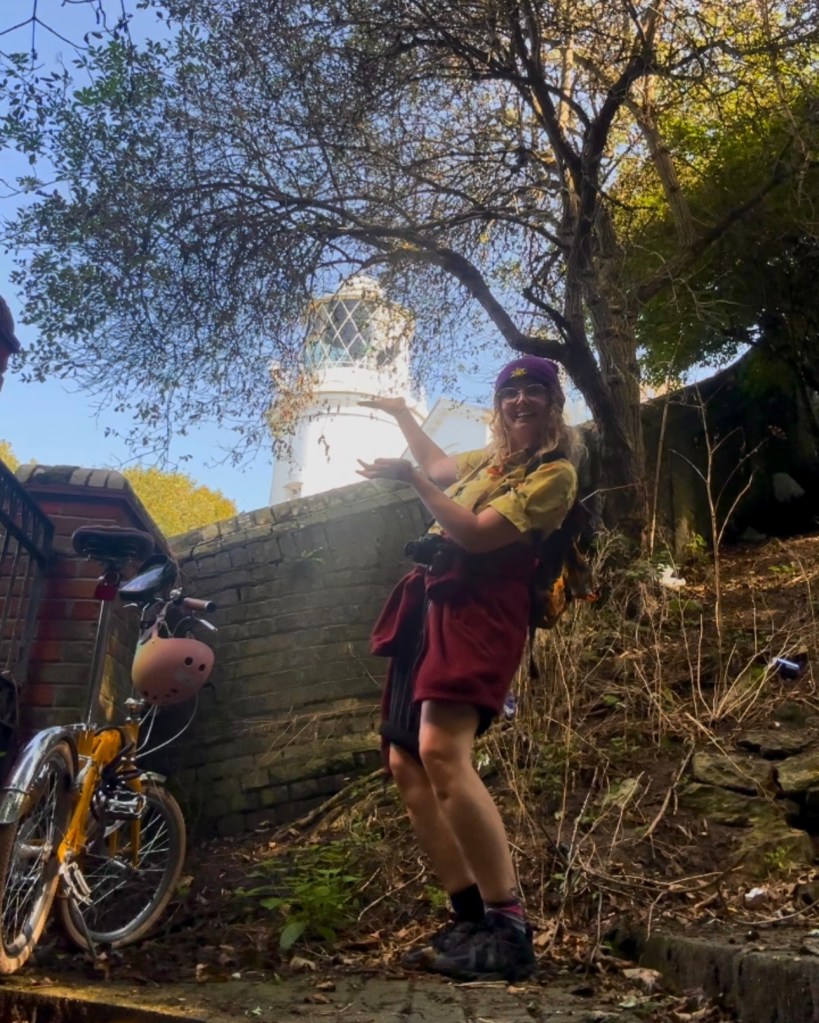
Once at Lowestoft train station, it was just a hop, jump and a skip to the lighthouse (an 8-minute cycle ride). The lighthouse itself isn’t open to the public, and there are a fair few signs which declare it to be private property. I approached from the road, and then got a better view of the lantern room by descending the stairs of ‘Lighthouse Score’.
The Trinity House website provides a wealth of information about this lighthouse. However, here’s a quick summary of how it came to be! In 1609, Trinity House responded to appeals from shipowners and merchants who had suffered losses due to shipwrecks on the East coast of England. They proposed building two towers, known as “high and low lights,” to guide ships safely through the dangerous passage between Lowestoft and Winterton. These initial lighthouses were established on the low-lying foreshore of Lowestoft-ness, using tallow candles as their source of light. Over the years, the lighthouses were rebuilt and improved, eventually adopting coal fires, oil lamps, and reflectors to enhance visibility. By the late 18th century, technological advancements led to the adoption of Argand lamps and parabolic reflectors, providing a more efficient and far-reaching light.
In 1870, plans were made to electrify the High Light at Lowestoft, but due to the availability of paraffin oil, it was ultimately used instead of electricity, proving more economical and efficient. The new lighthouse tower, built in 1874, featured a revolving lens and a flashing light for improved navigation. By the early 1920s, the low light was extinguished, as the Stamford Channel had disappeared and the light was no longer needed. The High Light was automated in 1975 and modernised in 1997. Today, it is monitored and controlled remotely from Trinity House’s Planning Centre in Harwich, Essex.
Why you should visit Lowestoft Maritime museum
After getting a good look at the lighthouse, and grabbing an ice cream from the nearby Martello Coffee House, I went to Lowestoft Maritime Museum. Positioned next to Sparrow’s Nest Bowls Club, the museum itself is a tiny treasure cove of local history. There was plenty of lighthouse memorabilia, including a lovely little model of the low light which was discontinued in 1906.
The low light was positioned in line with the high light to help mariners navigate through the sand banks. As the sand banks moved, the light would’ve been moved along the beach to ensure the boats’ safe passage.
In addition to the model, there was the old lens clock mechanism from the high light. This was used from 1900 to 1975 before the lighthouse was automated. This mechanism ensured that the lighthouse kept turning but became redundant when electrified.
The lighthouse-related tidbits were fantastic, however the museum as a whole was an interesting insight into what happened to Lowestoft. This seaside town shares the same history of many, going from a seaside hotspot in the 1800s to desolate in the modern day. It’s well worth a visit if you’re in the area. Especially as you can’t go inside the lighthouse!
 Lighthouse Explorers