
Introduction to Cape Wrath Lighthouse
The Cape Wrath Lighthouse is perched on Scotland’s most northwesterly extremity, amidst the wild Scottish Highlands. Its isolated situation makes it quite the adventure to get there, and it has a history intertwined with the legacy of the famed Stevenson family, eminent in lighthouse construction in Scotland.
History of Cape Wrath Lighthouse
Erected in 1828, the Cape Wrath Lighthouse was the brainchild of Robert Stevenson, part of a dynasty whose maritime safety contributions have withstood the test of time. It was established to assist ships navigating the dangerous waters of the North Atlantic, marking the northwesternmost point of the British mainland. The automation of the lighthouse in 1998 heralded the end of the lighthouse keeper’s era, ushering in a new epoch of technology-driven maritime safety.

The Stevenson family, over several generations, were responsible for the construction of an impressive number of lighthouses; they designed and built over 90 lighthouses around the coast of Scotland. Robert Louis Stevenson, the famous author of “Treasure Island” and “Dr. Jekyll and Mr. Hyde,” was part of this family, though he chose to pursue writing instead of the family’s engineering profession.
The Stevenson lighthouses are renowned for their quality and the advances they brought to lighthouse design, with many of them still in operation today, albeit now automated and no longer manned by keepers.
Journey to the Edge of Scotland
Venturing to Cape Wrath is an expedition into the heart of the Highlands, an area renowned for its staggering landscapes and cultural richness. It’s worth travelling to the proximate towns of Durness and Ullapool to commence your journey to the lighthouse!
From Keoldale, a small passenger ferry transports passengers across the Kyle of Durness. This brief crossing often provides travellers with their first true taste of the area’s rugged beauty.
An all-terrain minibus journey winds across the moorland to the lighthouse, a passage not suited for the faint-hearted. For those who opt for it, the 11-mile hike to the lighthouse is a pilgrimage through some of Scotland’s most unspoilt environments, promising solitude and serenity. Alternatively, there is a bumpy bus ride to the lighthouse, although this is very slow and may cause travel sickness!
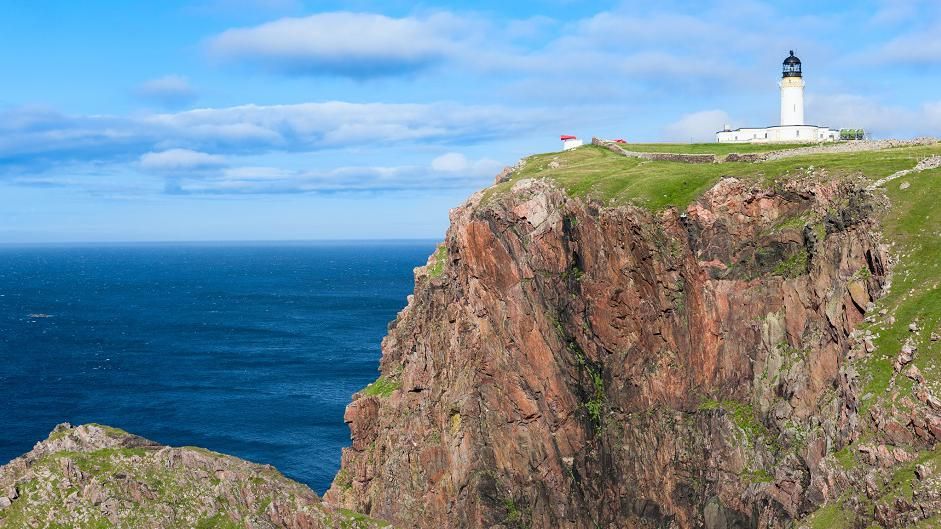
The Lighthouse Itself
The 20-metre tall granite tower of the Cape Wrath Lighthouse is an architectural marvel, conceived to withstand the severe Scottish climate. It’s mainly white, with a black coating on the lantern and vent ball.
Before the advent of automation, the life of a lighthouse keeper at Cape Wrath was marked by isolation and endurance. Keepers maintained it through relentless weather, ensuring the safety of maritime traffic. There would have been lighthouse keepers and assistants in constant rotation on the lighthouse, offering some reprieve from the daily duties.
The transition to automation marked the conclusion of an epoch, as the lighthouse became fully automated, continuing its crucial role in safeguarding seafarers without the need for a constant human presence.
Cape Wrath is a sanctuary for a diverse array of wildlife and plant life. As a designated SSSI and Special Area of Conservation, it supports myriad bird species and unique vegetation, establishing it as a pivotal site for naturalists and conservationists. Notably, the Golden Eagle is commonly seen soaring around Cape Wrath, they’re believed to be actively breeding on the Cape Wrath peninsula.
Military Presence and Access Restrictions
At times, the Cape Wrath region is utilised by the Ministry of Defence, which can lead to limitations on public access. It’s worth checking the restrictions when you go, as this access changes based on the season.
You can check restrictions and up-to-date advice here.
Cape Wrath in Popular Culture and Tourism
The lighthouse and its environment have seized the imagination of filmmakers, photographers, and authors. It draws tourists seeking to experience one of Britain’s final great wildernesses.
For long-distance cyclists and hikers, Cape Wrath represents a formidable challenge, frequently forming a segment of the route from Land’s End to John o’Groats.
 Lighthouse Explorers