
Last week, I was on an epic tour of ten lighthouses up in Scotland. This is only approximately one twentieth of Scottish lighthouses but alas, I will just have to go back at another point in time.
This roadtrip began at St Abb’s Head on the Scottish border, and concluded at Turnberry Lighthouse.
Sit back, relax, and come along for the ride!
St Abb’s Head Lighthouse
Our first stop after 1 1/2 days of travelling (and a small collision between my dad’s car and a lamppost) St Abb’s. St Abb’s is a village and a nature reserve, located just past the Scottish border. Within the village is St Abb’s Head Lighthouse, built by David and Thomas Stevenson. During this tour of Scottish lighthouses, we mainly ended up seeing lighthouses built by the Stevenson family.
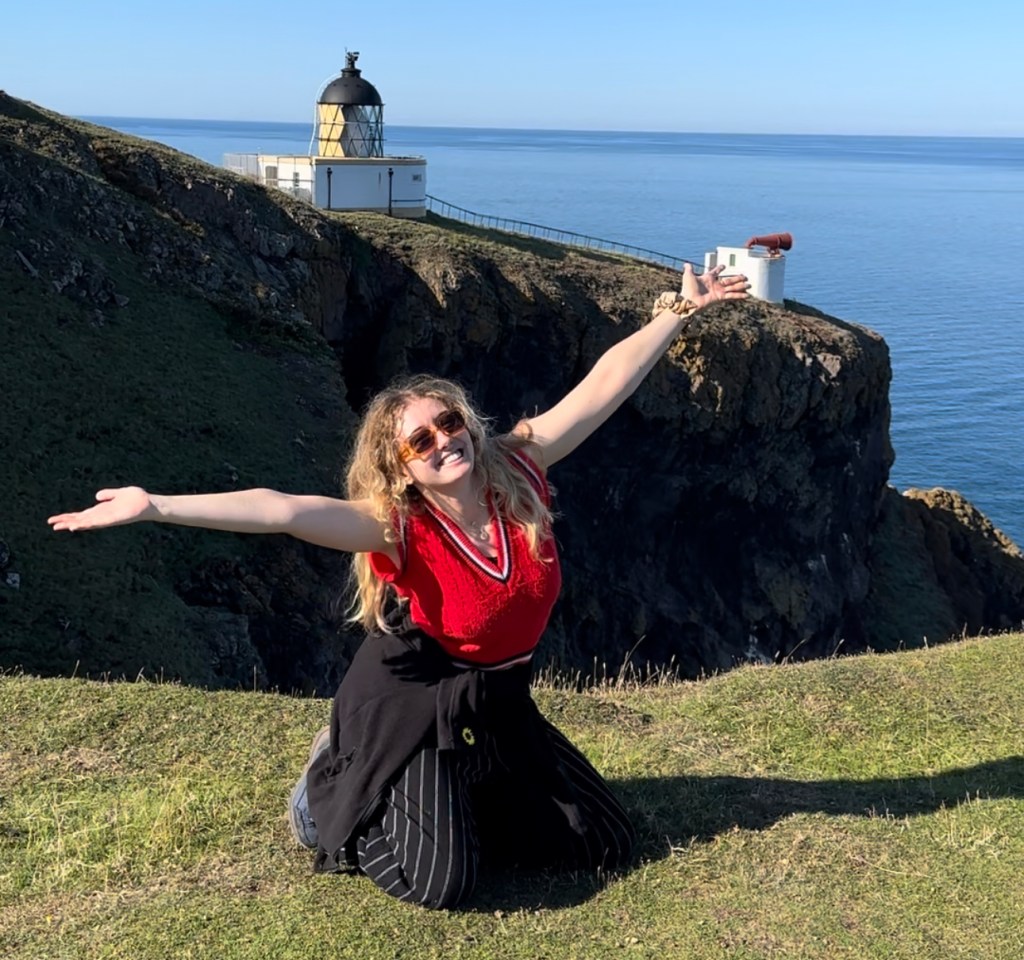
The Stevenson family built over 90 lighthouses across Scotland, and I’ll dedicate an entire blog post to them as they’re very similar to the Douglass family in many respects. For context if you haven’t heard the podcast episode, the Douglass family built many lighthouses across Cornwall and the Scilly Isles down South.
This lighthouse’s build was prompted by the shipwreck of the Martello in 1857. This adorable little lighthouse was then built to protect future mariners from the treacherous area around Carr Rock.
Bass Rock Lighthouse
Our next stop on the great Scottish Lighthouse Tour of September 2023 was Bass Rock Lighthouse.

Bass Rock was one of the most beautiful lighthouses on the trip. While we saw a lot of mainland lighthouses, this lighthouse appeared to be cut into the island. There is a fantastic view of it from the beach next to Drift coffee, if you don’t mind a slightly perilous walk down a sandy hill. If you do mind, you could park up and enjoy a coffee while admiring the view, and watch other people trip over themselves while they go down to the beach.
Bass Rock lighthouse was built in 1902 by yet another David Stevenson. He demolished some of the 13th-century castle on the mainland for the stone. If you go to the castle now, you will be able to see that it has seen better days. The lighthouse looks great though!
Girdleness Lighthouse

Girdleness Lighthouse was positioned in a pretty bleak location, at least compared to some of it’s counterparts. It overlooks the Aberdeen harbour, and is nestled in a golf course, next to a lot of noisy machinery. It’s also a short distance from a park with no bins, so prepare for that accordingly.
Aside from all that, this lighthouse was engineered by Robert Stevenson, and first lit in 1833. The build was prompted by a shipwreck 20 years prior. The Oscar, a whaling ship, crashed on the rocks, with only 2 out of the 45 members of the crew surviving. There were reports that this was due to them being incapable drunkards, but the lighthouse was built regardless.
During the 2nd world war, a mine drifted ashore and exploded! Despite the potential for absolute pandamonium, damage to the lighthouse was confined to the doors and windows in the lighthouse keeper’s house and the tower itself.
Buchan Ness Lighthouse
Buchan Ness Lighthouse stood out from the lighthouses on this trip due to its beautiful red and white striped exterior! Most of the lighthouses we saw were either white, or white and yellow. Whilst this is obviously still beautiful, my favourite lighthouses all have these stripes in common. For example, Beachy Head Lighthouse on the South Coast of England, and Happisburgh Lighthouse in Norfolk.
Petitions were received by the Commissioners in 1819 from the Magistrates, Town Councils and Harbour trustees of Peterhead, to have a lighthouse erected on Buchan Ness or another suitable part of the coast. It wasn’t until 1827 that the light was first exhibited. John Gibb of Aberdeen was the contractor responsible for building the lighthouse. The red bands were added in 1907 to distinguish it as a day mark.

During World War Two, a drifting mine washed ashore and exploded 50 yards south of the station. Whilst no one was injured, the material damage consisted of three cracked lantern panes and 12 other glass panes broken in the tower, engine room and dwelling houses. The additional damage included 20 slates blown off the roof storehouse.
Rattray Head Lighthouse

We had the most glorious wild camping spot next to this tower, shielded by sand dunes on either side. A deserted stretch of beach lay before the towering Rattray Head Lighthouse, which played host to a flock of black birds for the entirety of our visit. The clouds were low and menacing, and as the light went down we were blessed with the three white flashes of this tower’s character, flashing at 30 second intervals. At night these flashes penetrated the tent’s canvas, providing a comforting reminder that the lighthouse was watching over us.
This lighthouse was built in 1895 by David Alan Stevenson, and Charles Alexander Stevenson. It was then automated in 1982. Any keepers positioned here wouldn’t have felt too isolated from the mainland, as the lighthouse is accessible at low tides.
I would obviously highly recommend going to all of these lighthouses and beyond, but if you have to choose one, choose Rattray Head Lighthouse.
Scotland’s Lighthouse Museum + Kinnaird Head Lighthouse
The Scottish Lighthouse Museum was an absolute bloody gem! We went expecting Kinnaird Head Lighthouse on its own, and were woefully unprepared for the brilliance of this little museum. The staff were absolutely lovely, and the museum itself featured tons of lighthouse lenses, taken from lighthouses all over the country.
The museum also had plenty of information about the famous Stevenson family and their contribution to Scottish lighthouse history! Within this wealth of knowledge, there was a very helpful family tree. The three David Stevensons were baffling my brain, so this was a very welcome sight!

Kinnaird Head Lighthouse is built in a 16th century castle. This means it has the most interesting shape of any lighthouse I’ve been inside!
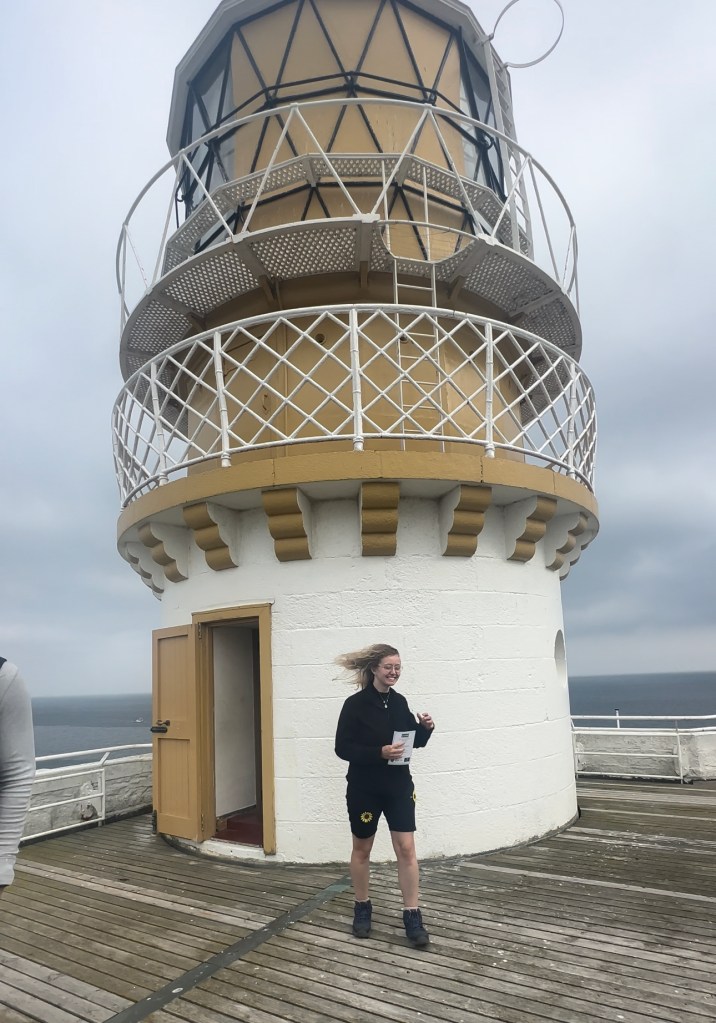
If you head along to the museum, it’s well worth hopping on one of the tours to go and have a gander. You enter through a traditional spiral staircase, which then branches off into old rooms of the castle.
Trainee lighthouse keepers in Scotland would be stationed at Kinnaird Head Lighthouse before being positioned at different lighthouses around the country, and you get to have a little peak into their room in the tower.
The tour rounds off with a look at how the light itself used to work, but this tower is now decommissioned and purely used as a historical site. Next door is the new Kinnaird Head Lighthouse, which is automated by the Northern Lighthouse board.
Strathy Point Lighthouse
We actually got to stay in Strathy Point Lighthouse on this trip. As a slight reprieve from wild camping, we nestled into a bright yellow room atop the majestic cliffs of Strathy Point. This lighthouse was decommissioned in 2012 and sold to be holiday cottages, with this specific apartment being available on Airbnb.
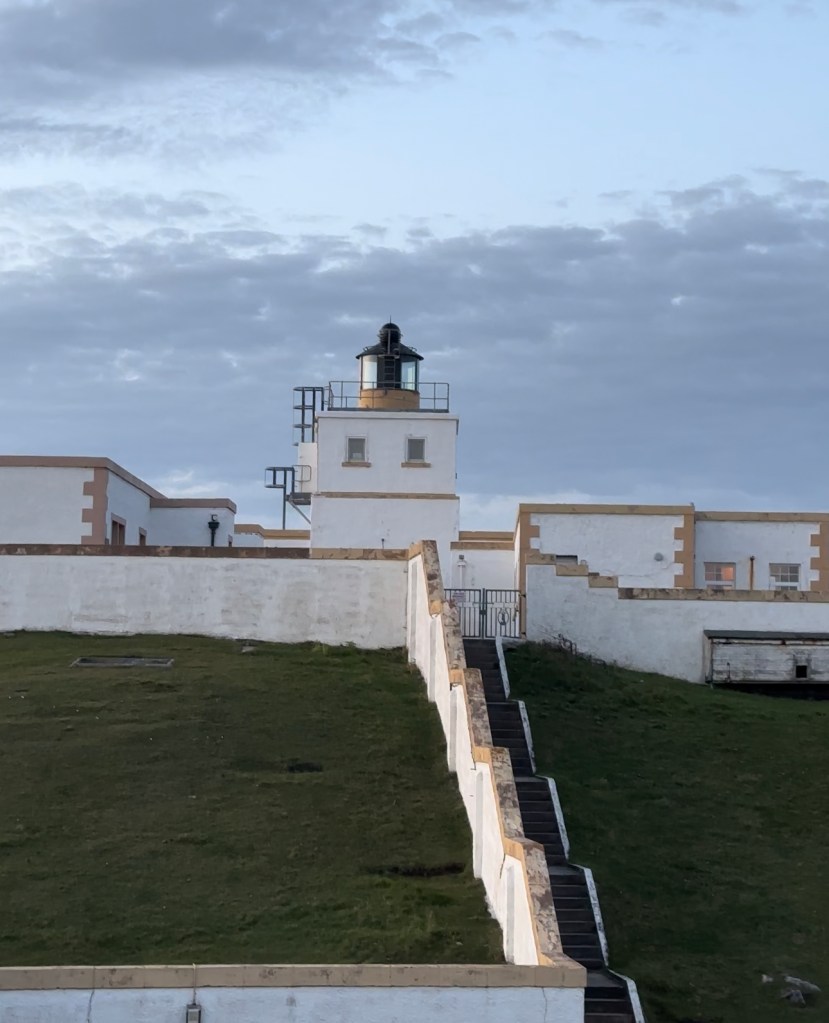

It took over 50 years for the lighthouse to be built, from the first proposal to its eventual lighting in 1958. It ended up being the last of the traditional manned lighthouses built in Scotland, and the first Scottish lighthouse to be built as an all-electric station. There was enough accommodation for three keepers, their families, and an Occasional Keeper!
In good weather, you can see mountains in the distance, and sit on the grassy banks next to the lighthouse to admire the sunset over the ocean. Well worth a visit.
Stoer Lighthouse
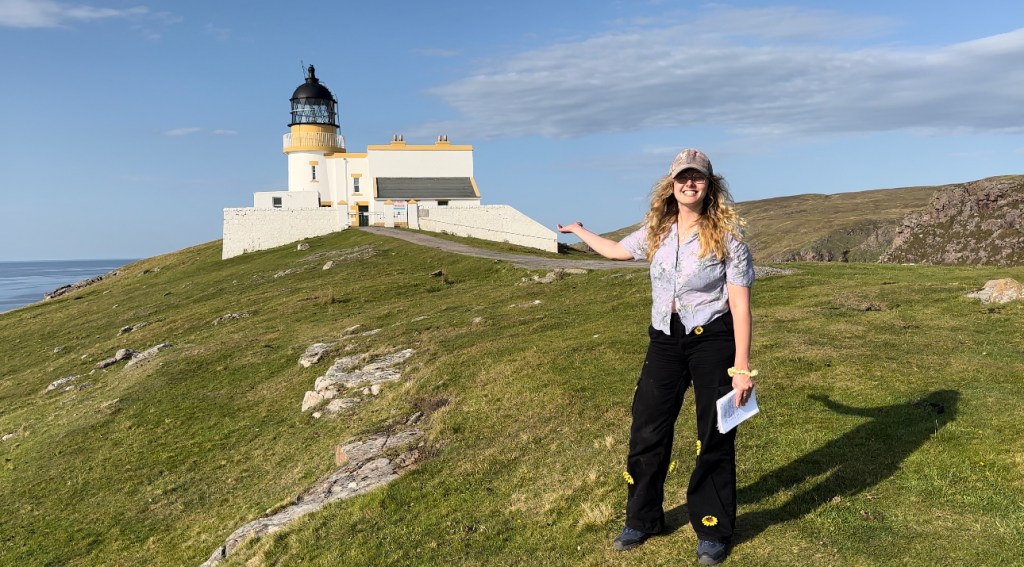
If you have any issues with mobility, and worry about having to walk a great deal to visit a lighthouse, Stoer Lighthouse may be for you! There’s a beautiful scenic drive round to a car park overlooking the lighthouse.
If you do fancy a walk however, you can trek up the adjacent hill to see the former byte, stable, cow shed, pig house and cart shed nearby. The keepers were pretty isolated at this lighthouse, and had to be self-sufficient for the most part. The lighthouse was one of the first to be established in Scotland, in 1870, and was built by Thomas and David Stevenson. It was automated in 1978, with over 100 years of lighthouse keeping coming to an end.
Corran Point Lighthouse

Corran Point Lighthouse was our penultimate lighthouse, and what a spot! I feel like my entire podcast is just gushing about lighthouses, but this one was very special. There’s a lovely estuary alongside, which is perfect for a little dip, and lots of sheep around, guarding the lighthouse.
This is also a very momentous lighthouse, it was one of the first lighthouses in Britain to become automatic in 1898, approximately 10 years before any lighthouses in England! It was again built by the Stevensons, and is a very pretty tower, with the glass being red and green!
Turnberry Lighthouse
Our final lighthouse was Turnberry Lighthouse, and it was a pretty anticlimactic end to the trip. Unfortunately, Trump has bought the golf course right next to it. If you do want to go, maybe scuff your feet along the grass a bit.
The lighthouse was first lit in 1873, in the days before Trump existed, the good times, and if you want to avoid the golf course you can access it along the Ayrshire Coastal Path.

Thank you for joining, Lighthouse Explorer! The next lighthouse trip is imminent, and I’m so excited to have you on the journey.
If you want to reach out, you can do so at annie@lighthouseexplorers.com or via our TikTok!
 Lighthouse Explorers
One thought on “The Great Scottish Lighthouse Tour of September 2023!”